NEWS
Building Safety Act Roundtable: Lessons from Gateway 2 and What Comes Next
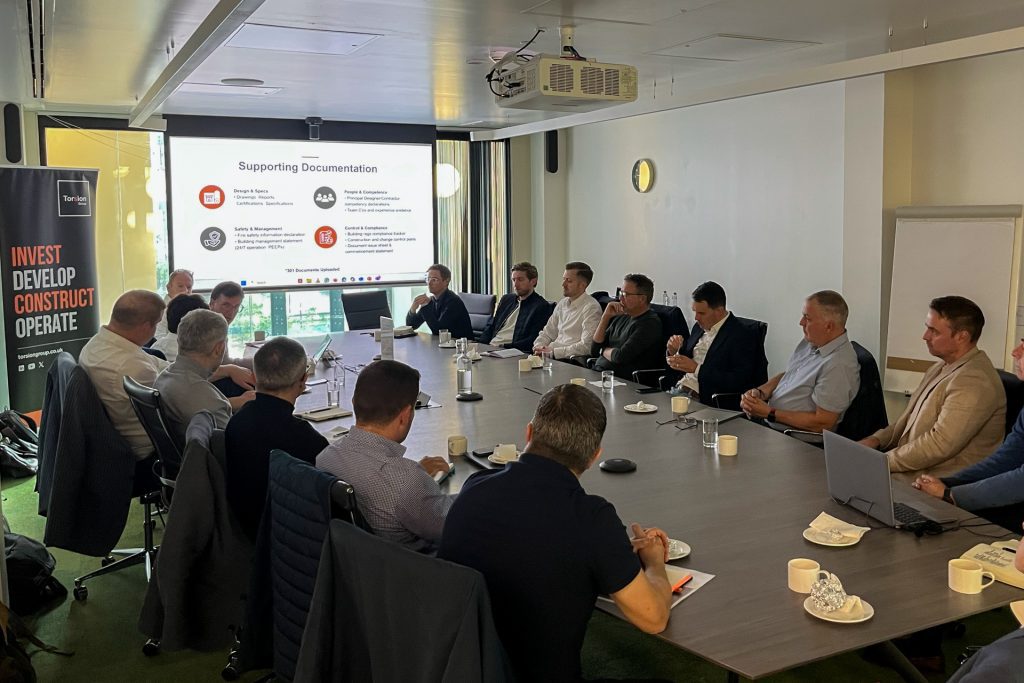
Last Friday, Torsion brought together colleagues from across the construction and property sector for a roundtable on the Building Safety Act. The discussion centred on the realities of Gateway 2, the lessons learned from recent submissions, and the challenges and opportunities that lie ahead as the industry approaches Gateway 3.
While there can be frustrations, no one questioned the principle of the Building Safety Act. At Torsion, we are helping to raise standards across the sector, strengthen collaboration between design teams and contractors, and highlight those operators who are not committed to long-term quality. The Act reinforces the values we have built our business on and provides an opportunity for reputable operators like ourselves to stand out.
Gateway 2 has been resource-heavy for everyone involved. Our own Kirkstall Road project took 12 months to achieve a successful determination, partly because we were among the first to go through the process, and the regulator was on its own learning curve. Encouragingly, others reported that recent submissions are now achieving a determination in approximately six months, although regional inconsistencies persist. That unpredictability was described as a “lottery” by many around the table.
Attention is also now turning to Gateway 3. The hope is that it will be smoother, but most agreed that the next six months will be critical, and we may see new challenges emerging. In response, some developers are redesigning schemes, such as splitting larger developments into separate buildings.

There was also recognition that the regulator is also focused on how a building will be operated once it is occupied. Questions are now being asked about building management strategies post-handover; for example, whether developments will have 24-hour security, concierge services, or fire watch procedures. As an operator, Torsion can integrate this into our model, but for others, this may prove more complex.
A wider theme was the comparison with Scotland, where a different regulatory approach is in place. The House of Lords’ request for information may hint at moving towards a Scottish-style warrant system in the future. This shows that the regulatory landscape is still evolving, and industry voices remain important.
The consensus was clear: while the Building Safety Regulator needs more resources and clearer processes, we as an industry must keep adapting and working together. The Building Safety Act is here to stay, and by approaching it with openness, preparation, and collaboration, we can make it a force for positive change.